
Build skills around a project that matters.
Business leaders, engineers, AI specialists, and domain experts learn together on one capstone your organization chooses. UME.Studio builds a custom curriculum around your objectives, and the team presents a working proof-of-concept to your leadership.

Capability your organization can see and use.
Attendance shows who took part. The capstone shows what the team can do. Adoption is the work continuing after the program.
-
Cross-functional by design
Business, engineering, AI, and operations roles learn together, so a project's business and technical sides share one understanding.
-
Tied to a real challenge
Learning happens on a capstone from your own operation, not a generic exercise.
-
Assessed, not only attended
The team's starting point is assessed during scoping, the capstone is evaluated against agreed success criteria, and instructors see every workstation during sessions.
-
Work that continues
After the program, you decide whether the team keeps its workspaces, Replay, and the agent's knowledge, so the project can move forward.
Who takes part, and what each role contributes.
Each person goes as deep as their part of the project needs. Not every role writes code.
- Business leader
Chooses the opportunity and sets the goals
Identifies where physical AI can create value, in your own operation or for your customers. Defines the business objectives and leads the capstone's goals and success criteria.
- Engineer / developer
Builds what the team tests
Builds and integrates the simulations, applications, and digital twins the team needs to test the solution.
- AI / data specialist
Develops and evaluates the models
Develops and evaluates perception, prediction, or automation models, using relevant data and simulation outputs.
- Domain / operations specialist
Keeps the solution grounded
Brings operational requirements and real-world constraints, and judges whether the proposed solution would work in practice.
Live instruction, guided practice, and help when someone is stuck.
-
Live instruction and guided exercises
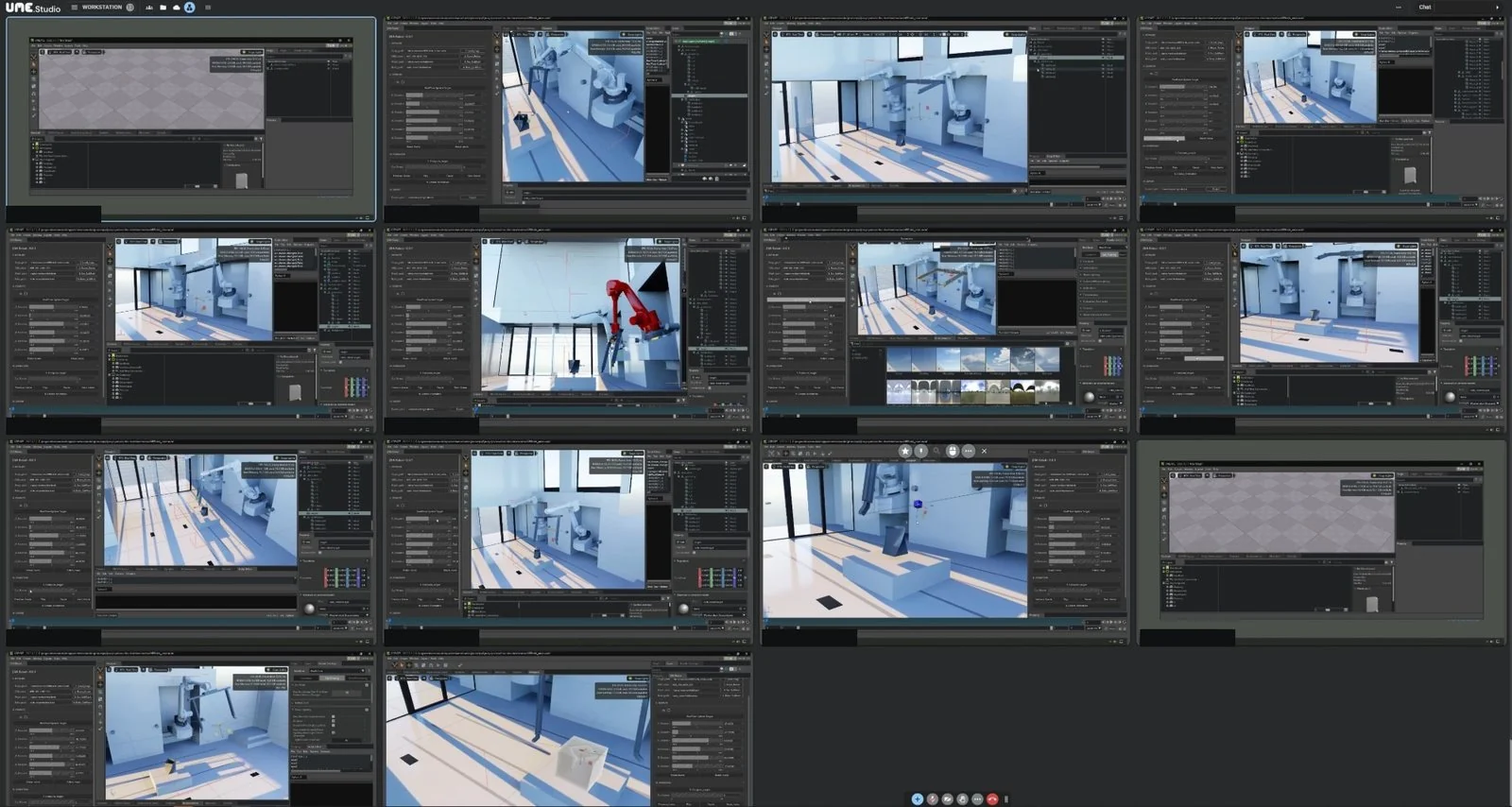
Instructors teach live in the tools the capstone uses, then guide exercises in browser workstations, seeing every workspace and stepping in where needed.
-
Catch-up with Replay
Ask the UME agent what you missed and return to that moment.
-
Expert office hours
Weekly office hours with UME.Studio experts while the team builds the capstone.
-
Responsible by design
Risk, ethics, and data security are covered alongside the technology.
What happens before, during, and after the program
-
Scoping
Define the opportunity
Your business leader identifies the opportunity and, with UME.Studio, sets the capstone's business objectives and success criteria.
Outcome
Capstone goals and success criteria agreed
-
Before day one
Prepare curriculum and environment
We build a custom curriculum around your objectives, and prepare a workstation for every participant with the software the program uses.
Outcome
A custom curriculum, workstations ready
-
Hands-on, multi-day
Learn by doing
Live instruction and guided exercises in digital twins, simulation, synthetic data, and optimization, at the depth each role needs.
Outcome
Shared fluency across every role
-
3–6 weeks
Build the capstone
The team builds a proof-of-concept on the opportunity its business leader chose, with instructors supporting them and weekly expert office hours.
Outcome
A working proof-of-concept
-
Capstone review
Evaluate and plan next steps
The team measures the result against the success criteria and presents it to your leadership. The capstone is the first step of a project, not a graduation exercise.
Outcome
A recommendation your leadership can act on
Examples of what a capstone can produce
The curriculum follows your objectives and the tools you use. Most programs draw on these four areas.
-
Digital twins
A physically accurate twin of a line, cell, or facility, ready to test changes before making them.
-
Robotics and automation
A robot, vehicle, or machine trained and tested in simulation before it touches hardware.
-
Vision models
A perception model for inspection or tracking, trained with synthetic data from the simulation.
-
Optimization
A route, schedule, or resource plan, compared against the way the work is planned today.
Time, team, and what you receive.
- Time
- 20–50 hours.Live training and expert office hours. The schedule and expected participant commitment are agreed during scoping.
- Timeline
- 3–6 weeks.To a working proof-of-concept.
- Team
- Up to 20 people.Business leaders, engineers, AI and data specialists, and domain or operations specialists.
- Prerequisites
- Assessed during scoping.We assess your team's starting point and build the program around it. Project, data, software, and participant-time requirements are agreed during scoping.
- Your leader
- A business leader who owns the capstone.
- Deliverables
- A working proof-of-concept and a recommendation.On an opportunity your organization chose, presented to your leadership with the case for next steps.
- Assessment
- Starting point and capstone.
- Afterwards
- You decide.
- Investment
- Programs start at US$50,000.
Start with one team, then scale.
- UME-led
Academy delivered by UME.Studio
UME.Studio designs and delivers the program around your team, your objectives, and your capstone.
- Larger groups
Successive cohorts
Run the program for further teams, across sites and regions, with a curriculum built around each team's capstone.
- Your trainers
Train the trainers
Prepare your own instructors to run programs on the UME.Studio platform, with your curriculum.
What teams ask.
Your business leader, working with UME.Studio during scoping. They identify the opportunity, set the business objectives, and define the success criteria. The engineers, AI specialists, and operations specialists shape how the team gets there.
No. Technical depth varies by role, and we assess the team's starting point during scoping. Engineers and AI specialists work hands-on in the tools. Business leaders and operations specialists learn enough to set goals, judge constraints, and evaluate results, without the same technical depth.
UME.Studio builds a custom curriculum, exercises, and capstone support around your objectives, and delivers the program live on a platform where instructors see every workspace. NVIDIA builds the technology: participants work with NVIDIA Omniverse, NVIDIA Isaac Sim, and NVIDIA cuOpt, delivered through our NVIDIA Education Partner program.
Nominate your first team.
Tell us who you would send and the opportunity you want them to work on.