From learning the technology to testing a business decision.

Digital twins become useful when a team can use them to answer a question that matters: where to place equipment, how to inspect a product, or whether a proposed change deserves investment.

Anonymous customer engagementAdvanced manufacturing

A manufacturing team puts its first digital twin to the test.

  • Five-day initial training
  • Follow-up office hours
  • Proof of concept delivered in six months
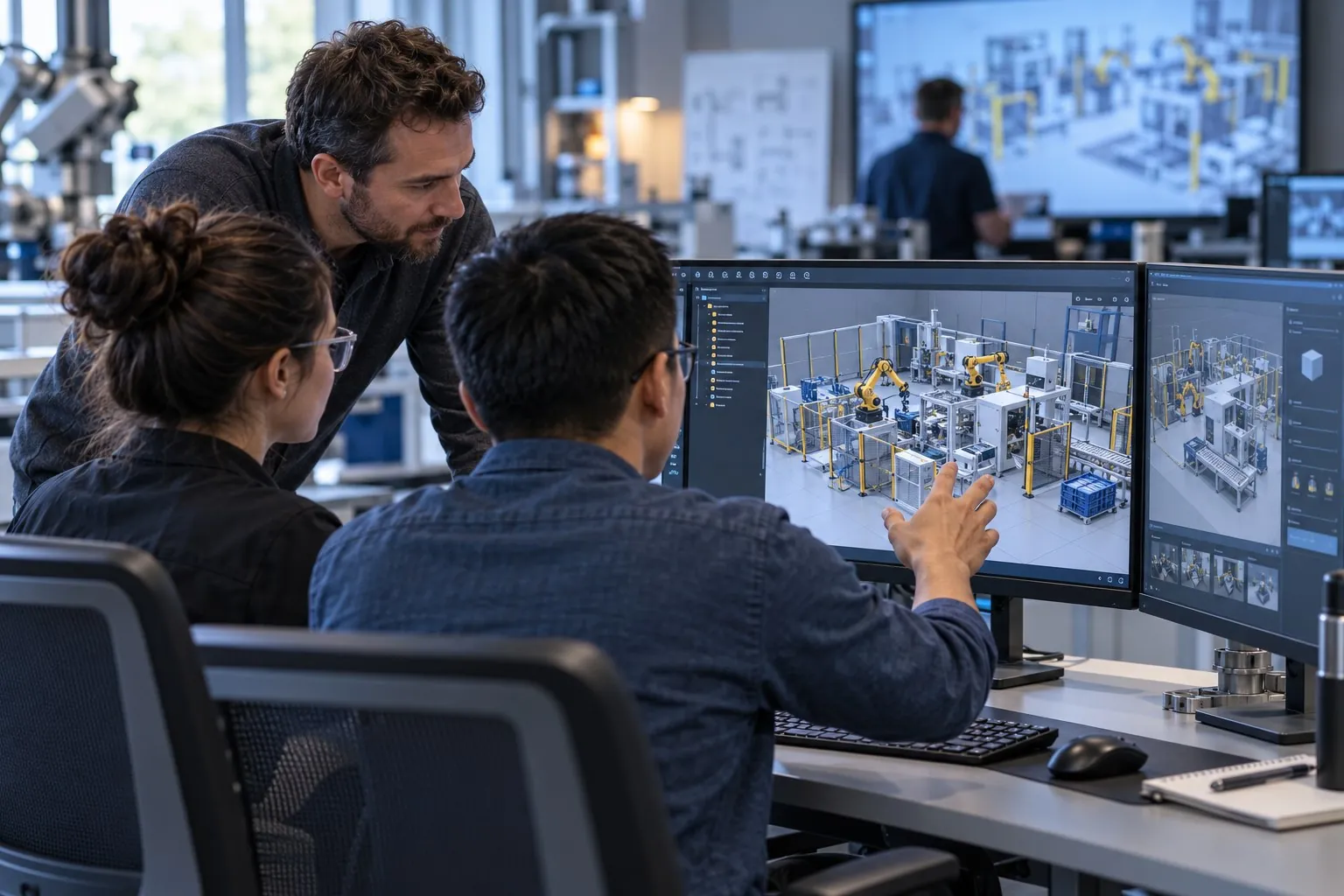
Engineers and an instructor reviewing a simulated manufacturing cell on a workstation.
Illustrative training scene. No customer facility or project data is shown.

A project ready to start. An environment that was not.

An advanced manufacturing team had identified a practical first use for digital twins: represent a manufacturing line virtually and explore how the technology could support its work. The obstacle was getting started inside an enterprise with demanding security requirements.

Bringing unfamiliar software and external expertise into the corporate environment required a lengthy assessment process. The team needed a way to learn and experiment while those constraints were addressed.

Training organized around the proof of concept

UME.Studio worked with the team to understand the project's goals, existing skills, and security constraints. Those requirements shaped a focused curriculum rather than a broad introduction to every feature of the technology.

The team began in an isolated virtual training environment, accessed through its browsers and separated from corporate networks. Five days of initial instruction were followed by office hours and practical support as the engineers applied NVIDIA Omniverse to their project.

Evidence the team could build on

The team completed its proof of concept in six months. It gave internal stakeholders a concrete demonstration of digital twin potential and showed that the engineers could develop the skills needed to continue.

At the time the engagement was documented, the team was working toward a more advanced second proof of concept, with a production pilot as the intended next stage.

Technology and delivery
NVIDIA Omniverse; UME.Studio virtual training workstations; custom curriculum; live instruction and follow-up office hours.

Anonymous customer engagementProfessional services / solution integration

Turning digital twin interest into working demonstrations.

  • 18 practitioners
  • Six-week program
  • 90% completed and presented a final capstone
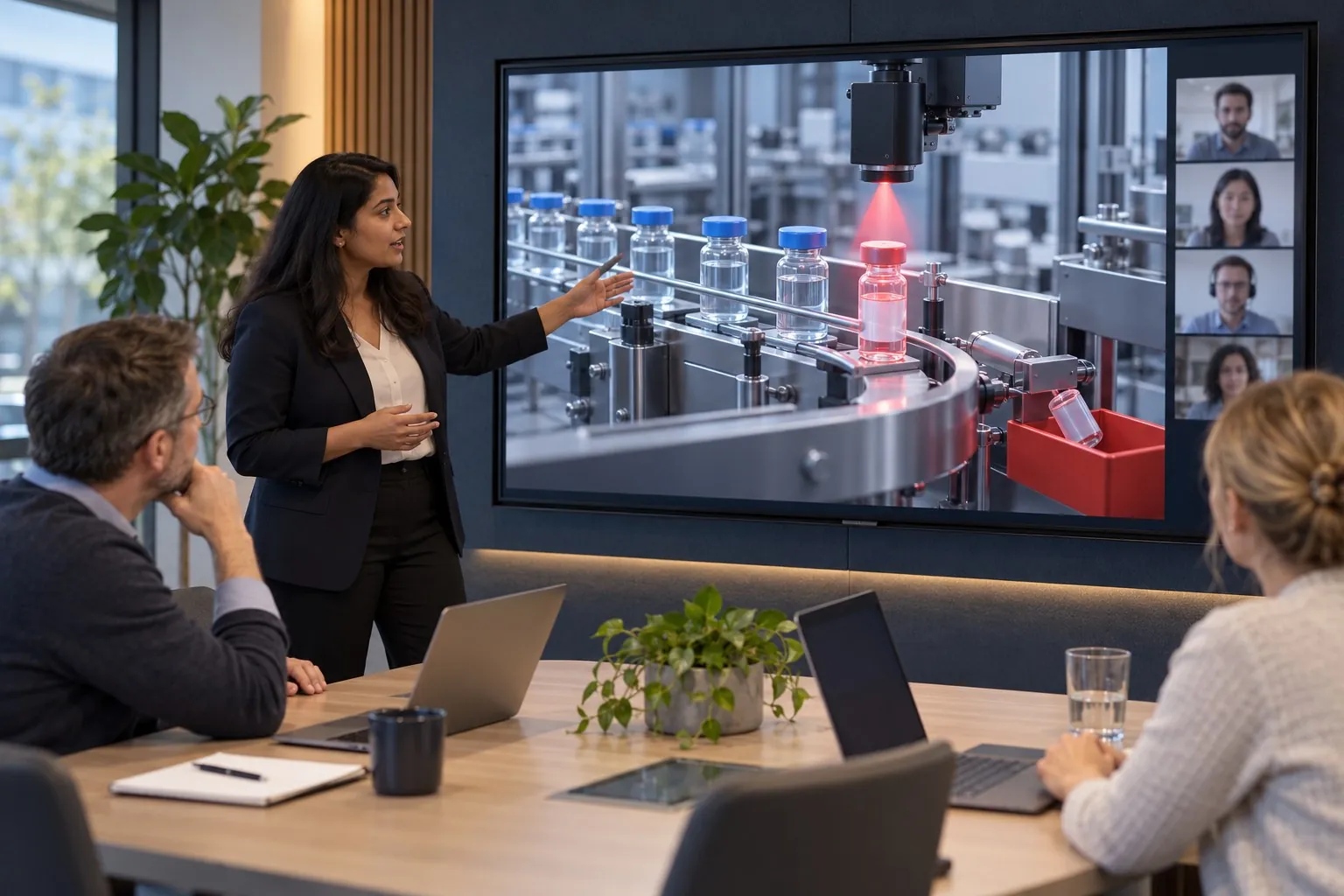
A practitioner presenting a simulated vial inspection application to colleagues.
Illustrative capstone presentation. The application shown is a visual interpretation, not a customer screenshot.

Client interest was growing faster than practical experience.

A global professional services firm had followed digital twin technology for years. As client interest grew, its internal technology community needed a way to turn that familiarity into practical capability.

The participants brought different backgrounds and levels of technical experience. Analysts, consultants, and managers needed to learn together while continuing their client work across a distributed team.

A working project became the learning path.

UME.Studio designed a six-week live practicum around a final capstone. Participants applied visualization, simulation, and data-connection concepts in NVIDIA Omniverse, using prepared virtual workstations and instructor support.

Breakout sessions and individual guidance gave participants room to progress from different starting points. The program ended with teams running their applications live for management, making the learning visible through working demonstrations.

One team developed a healthcare simulation in which vials passed through a virtual scanner and were analyzed and sorted using an NVIDIA NIM integration. It was a capstone demonstration of connected technologies, rather than a claim of a validated pharmaceutical production system.

Capability that could be seen and shared

Eighteen practitioners joined the program. The source case study reports that 90% successfully built and presented a final capstone. Alongside those projects, the engagement created an internal community with a shared practical foundation for further digital twin work.

Technology and delivery
NVIDIA Omniverse; NVIDIA NIM in one healthcare capstone; UME.Studio virtual workstations and collaborative sessions; live instruction and project presentations.

Two anonymous customer engagementsFulfillment and distribution

Before changing the fulfillment line, learn to work with the whole facility.

  • Two company engagements
  • Mechanical engineering teams trained
  • Preparation for a first proof of concept
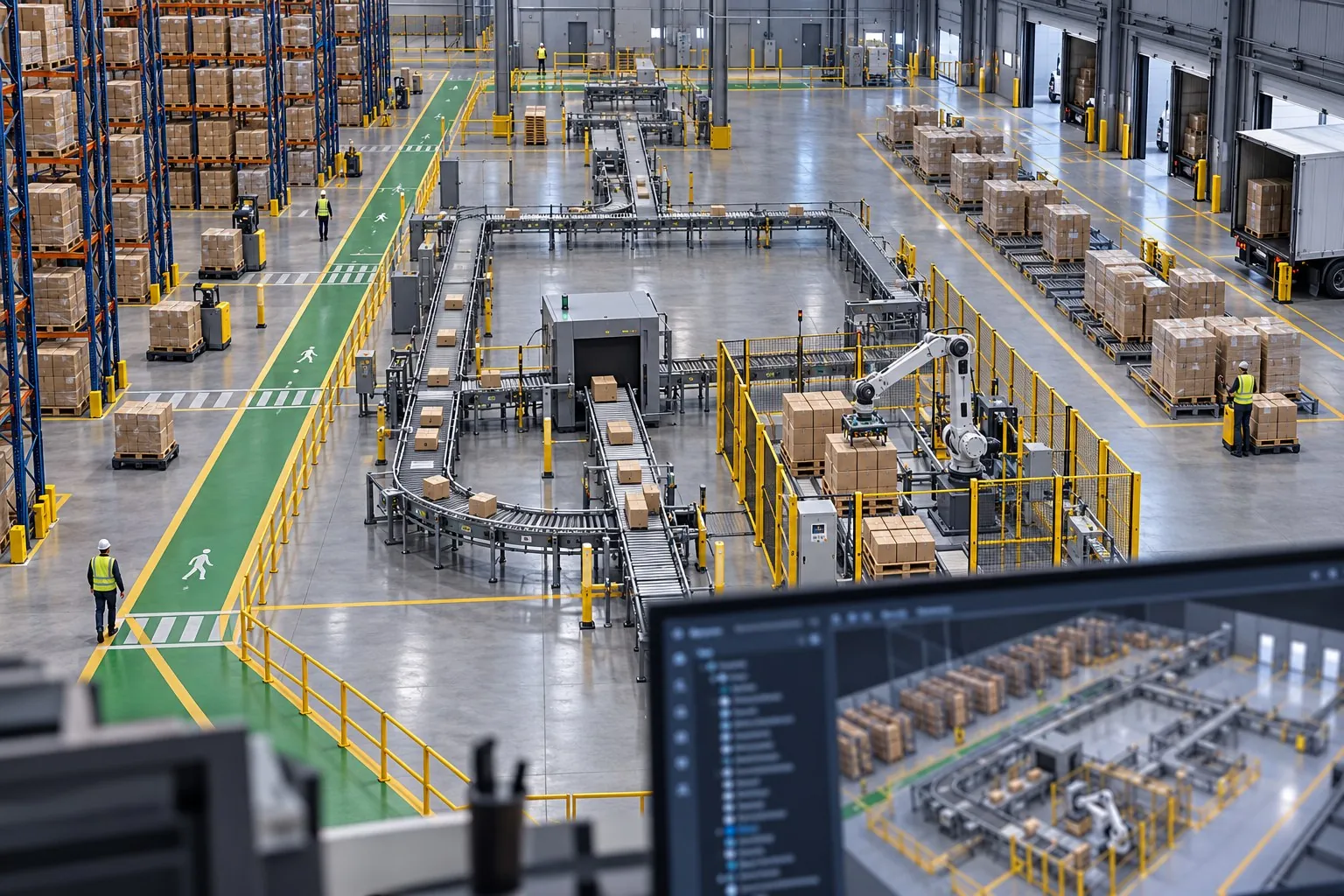
A virtual fulfillment facility showing conveyors, an inspection portal, guarded automation, and separate pedestrian routes.
Illustrative facility visualization. It does not reproduce either customer's layout.

A new station changes more than one section of conveyor.

Two fulfillment and distribution companies wanted to explore digital twins of their existing facilities. Their engineers were considering how revised layouts, inspection stages, and automation could fit into established fulfillment lines.

That meant understanding the facility as a connected environment. A proposed station needed to be considered alongside neighboring equipment, material flow, and access for the people working around it.

The first challenge was making a facility-sized dataset usable.

UME.Studio trained mechanical engineering teams in NVIDIA Omniverse and OpenUSD, with particular attention to managing the large datasets involved in representing an entire facility.

The work connected the technology to the engineers' own questions: how to organize a facility representation, explore equipment placement, and understand where inspection and automation might contribute value. OpenUSD provided the scene-management foundation for working with that scale of information.

A starting point for a useful proof of concept

These engagements were the teams' entry point into the technology. They built an understanding of what was possible and began the work toward proofs of concept relevant to their existing facilities.

The outcome at this stage was a foundation for further engineering work. Completed layout optimization, deployed automation, and measured throughput improvements are not claimed.

Technology and delivery
NVIDIA Omniverse; OpenUSD; tailored training for mechanical engineers working with large facility datasets.

Based on anonymous customer workPharmaceutical manufacturing

Train vial inspection on the defects that are hard to collect.

  • Customer-specific synthetic data for inspection-model training and refinement
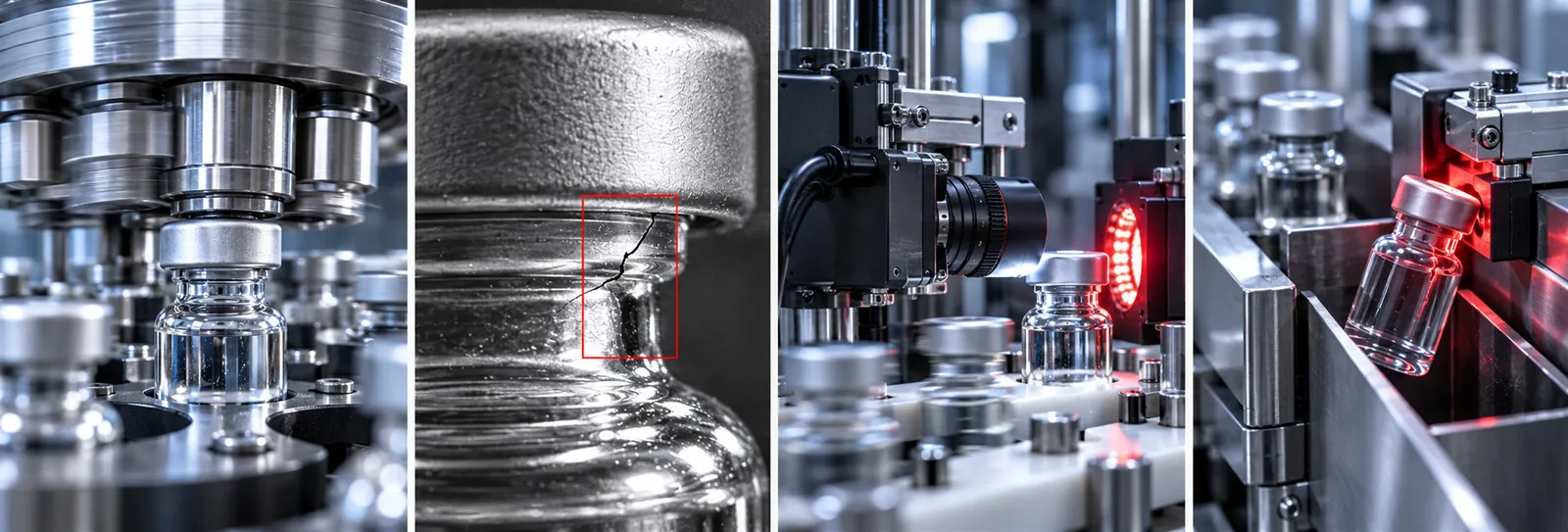
A sequence showing vial capping, a highlighted glass-rim crack, camera inspection, and red-lit rejection.
Illustrative inspection sequence. The rim crack and camera arrangement are editorial examples, not a reproduction of the customer's equipment or defect taxonomy.

The rare defect is often the one you most need to recognize.

Vision inspection on a high-speed pharmaceutical line depends on relevant examples of acceptable and defective products. Collecting those examples from production can be disruptive, particularly when defects are uncommon.

In work with a pharmaceutical customer, UME.Studio used synthetic data generated to match the customer's own equipment to support training and refinement of vision models.

Make the training data relevant to the inspection task.

A useful synthetic image must represent the conditions the model will encounter. Equipment geometry, viewpoint, illumination, and product appearance all influence what a defect looks like to a camera.

The accompanying visual explores a crack near a vial's glass rim beneath its cap. It makes the inspection problem tangible: detect a small defect, connect that detection to a specific vial, and separate it from the main flow. This is an editorial illustration of the application, rather than a claim about the exact customer implementation.

The decision is readiness for the line.

The purpose of this work is to help determine whether an inspection model is accurate enough and fast enough for its intended operating conditions. The supplied account does not establish a measured accuracy improvement, rejection rate, or completed production deployment.

Confirmed technology
Customer-specific synthetic data generation and vision-model training. Exact customer software and model names are withheld or unconfirmed.

Industry illustrationBattery module manufacturing

Put the laser cell in context before it goes on the floor.

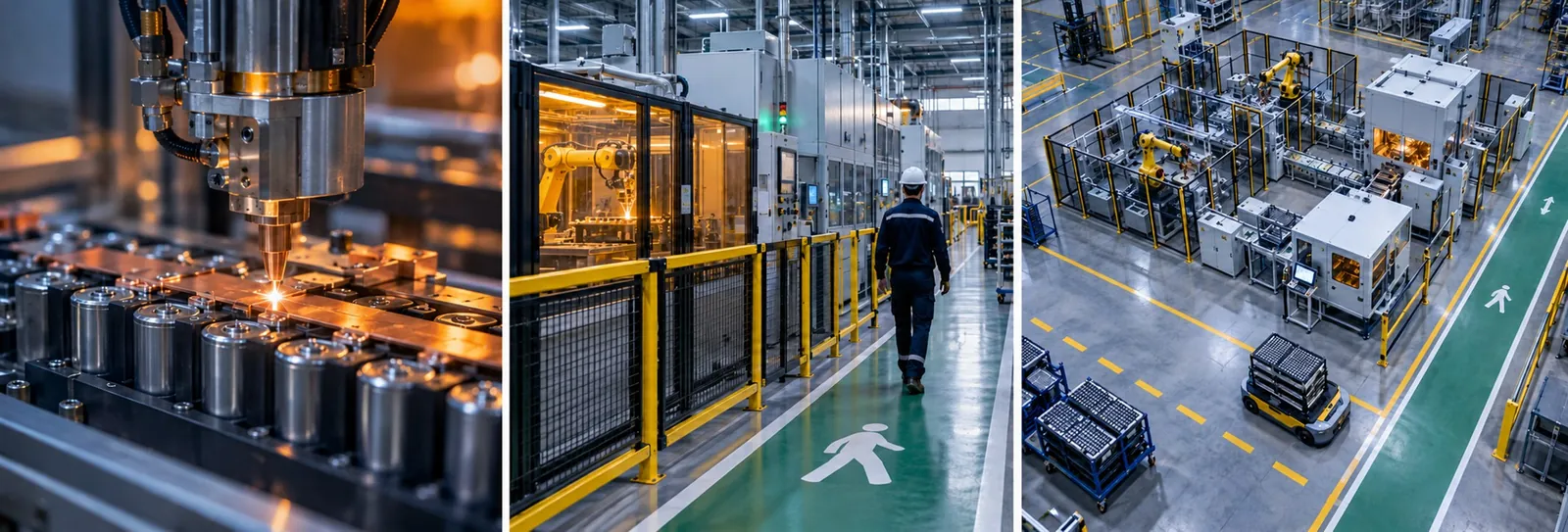
Battery busbar welding, a protected pedestrian route, and an elevated view of the factory layout.
Illustrative battery factory: process hazard, human access, and the wider layout.

A fast machine can still create a slow line.

A laser welding station may perform well in isolation while creating difficult handoffs around it. Modules need to arrive, operators need access, and inspection or rework must fit into the flow. Protective enclosures and service clearances also occupy real floor space.

A facility model could bring those decisions into one view. The team could compare equipment arrangements, material routes, and pedestrian access before moving hardware. Where timing and operating data are available, the project could extend from spatial review into flow analysis.

Decision to test
Which arrangement supports the required movement of modules while maintaining appropriate access and separation around hazardous equipment?
Proposed technology
OpenUSD for equipment assets and layout alternatives; NVIDIA Omniverse for a shared facility representation; NVIDIA cuOpt for suitably formulated material-routing or scheduling problems. Process simulation requires an appropriate model and operating data.
Potential value to evaluate
Less travel and queuing, practical maintenance access, and fewer conflicts between people and material movement. No achieved improvement is claimed.

Industry illustrationSolar module manufacturing

Add inspection without making it the solar line's bottleneck.

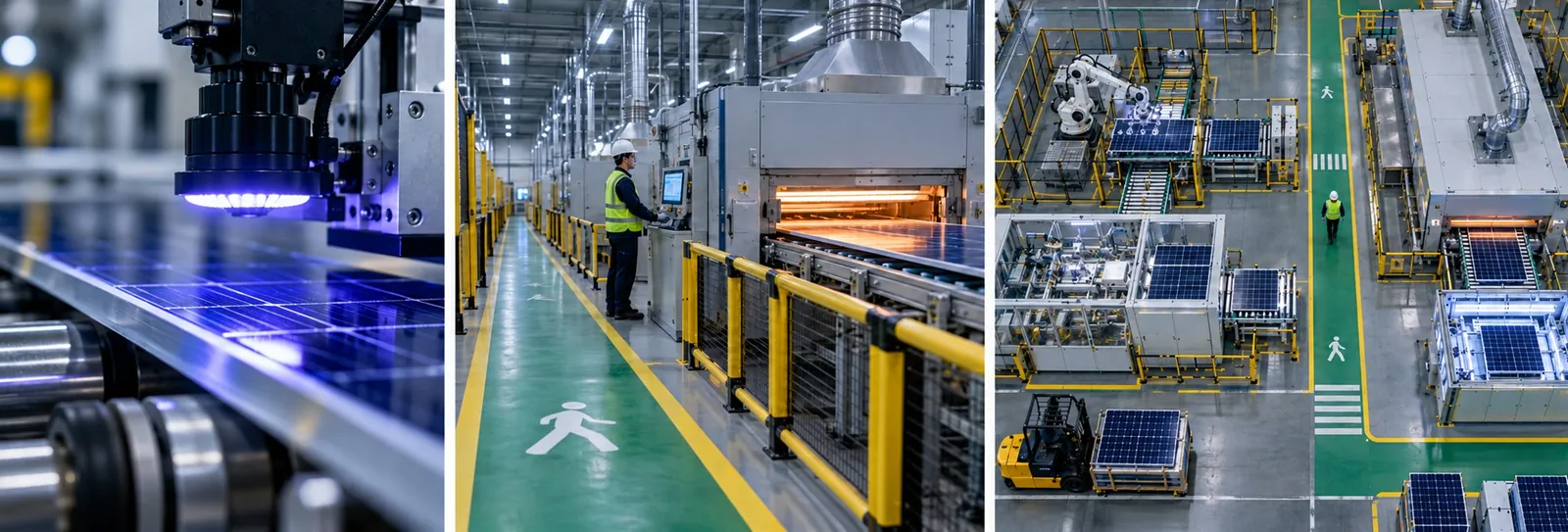
A solar-panel inspection camera, an operator beside a guarded laminator, and a bird's-eye factory view.
Illustrative solar factory: inspection detail, safe access, and equipment placement.

Quality control needs room in the production plan.

An inspection station needs more than a camera location. Panels must enter consistently, rejected products need somewhere to go, and operators must be able to reach the equipment without conflicting with glass handling or hot process stages.

A digital facility model could help a team compare placement options around lamination and handling equipment. A first study might focus on physical space and access. Further work could connect measured cycle times, buffer capacities, and defect-handling assumptions to investigate bottlenecks.

Decision to test
Where should inspection and its reject path sit so that quality checks support the intended production flow?
Proposed technology
OpenUSD and NVIDIA Omniverse for layout and equipment representation; camera and lighting simulation for inspection design; Omniverse Replicator where synthetic vision data is part of the scope. Cell microcrack inspection may require electroluminescence imaging, rather than an ordinary surface camera; the method depends on the defect.
Potential value to evaluate
Better inspection access, fewer handling conflicts, and adequate space for buffering and rejected panels. No production outcome is claimed.

Industry illustrationIndustrial heat pump manufacturing

Plan the space around heat, pressure, and people.

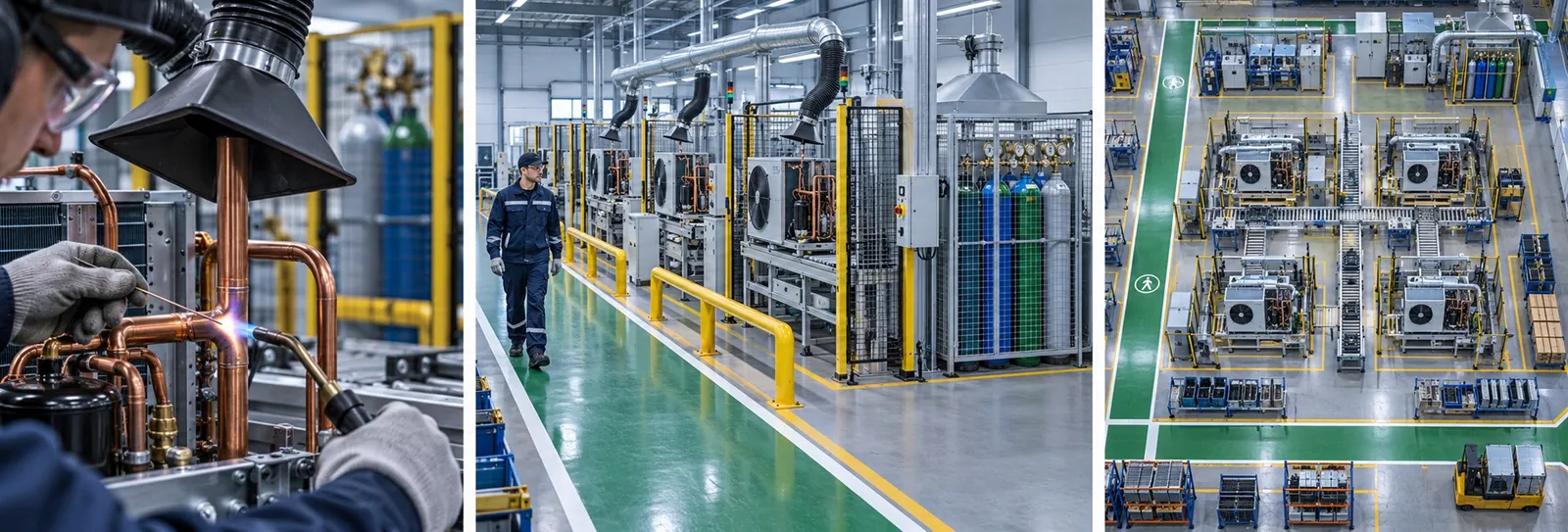
Copper-pipe brazing, a protected walkway beside gas-handling equipment, and an overhead heat-pump assembly layout.
Illustrative heat pump factory: a close process detail expands into the wider planning decision.

The equipment footprint is only part of the space required.

Brazing, refrigerant charging, pressure testing, and final assembly each bring different access and separation needs. A compact arrangement on a floor plan may leave insufficient room for materials, maintenance, or the people working around the line.

A facility model could help engineers and operations teams review those interactions together. Proposed layouts could represent guarded workstations, gas-handling areas, service clearances, pedestrian routes, and the path units take between stages.

Decision to test
How can the line support efficient assembly while providing the access and separation required around heat, pressure, and gas-handling equipment?
Proposed technology
OpenUSD for modular equipment and layout data; NVIDIA Omniverse for shared spatial review; optional routing or scheduling optimization using NVIDIA cuOpt where a suitable mathematical model is defined. Ventilation, hazardous-area requirements, and safety decisions remain subject to qualified engineering review.
Potential value to evaluate
Clearer access, fewer movement conflicts, and a layout that accounts for operating and service needs before equipment is installed.

Industry illustrationAerospace manufacturing

Follow one turbine blade to find the production constraint.

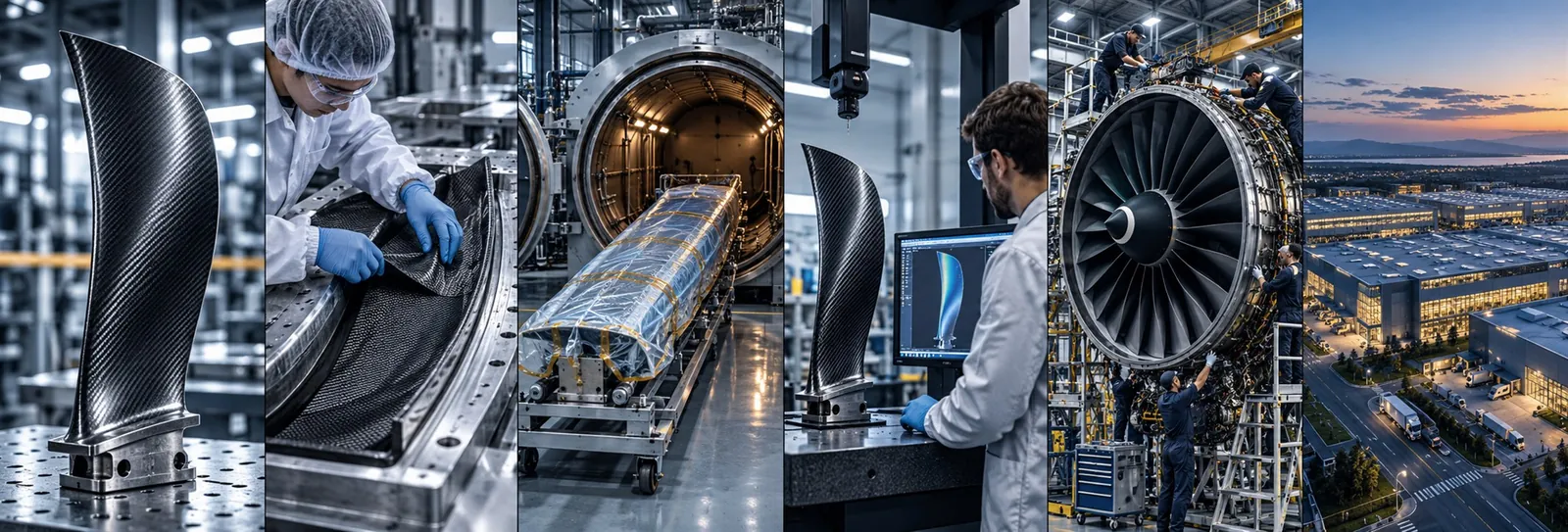
Composite aerospace blade preparation, layup, curing, inspection, engine assembly, and factory scale.
Illustrative composite aerospace blade workflow; representative imagery, not a specified customer's process.

More output may depend on a decision made several stages earlier.

A product's design affects how it is made. Process capacity affects queues. Inspection affects release and rework. The factory layout and availability of parts influence how those stages perform together.

An initial project could select one constraint and establish a useful model around it: curing capacity, inspection queues, or material movement, for example. The team could then compare options using the data and process assumptions needed for that decision, rather than attempting to simulate an entire supply chain at once.

Decision to test
Which change to the product, process, or facility is most worth investigating to improve output?
Proposed technology
OpenUSD and NVIDIA Omniverse for the shared product and facility context; appropriate engineering tools for process physics; operations models for capacity and queues; NVIDIA cuOpt for defined routing or scheduling problems. A 3D scene alone does not establish production performance.
Potential value to evaluate
A better-supported choice of where to invest engineering effort or capacity.

Public events

Workshops we designed and delivered.

  • Technology partner · Conference

    A hands-on physical AI workshop at NVIDIA GTC 2026

    Challenge: a hands-on session for a full conference room, on laptops nobody had prepared. UME.Studio designed the OpenUSD for Robotics Pipelines curriculum and delivered it live on its platform.

    OutcomeDelivered live to 80 attendees

  • I/ITSEC 2024

    Defense · Workshop

    A disaster relief simulation workshop

    Challenge: a hands-on digital twin workshop for a mixed military audience. With Naval Postgraduate School PhDs, UME.Studio developed a humanitarian assistance and disaster relief simulation scenario and delivered the workshop on its platform.

    OutcomeMembers of all military branches

Contact

Which decision would you test first?

Tell us about your operation, the team involved, and the decision in front of you. We will help you identify a practical first project and the skills needed to carry it forward.